12 / Bio inspired technology
Bio inspired tech: three systems, three lessons
An analysis of three living systems and what engineers have actually built from them: route finding and robot swarms from ants, low power chips from the fruit fly brain, and a new security problem from DNA sequencing.
- Ant colonies, the fruit fly brain and DNA
- Bio inspired technology
- September 2026
- Research and analysis
Context
Three living systems solve problems that computers still find hard.
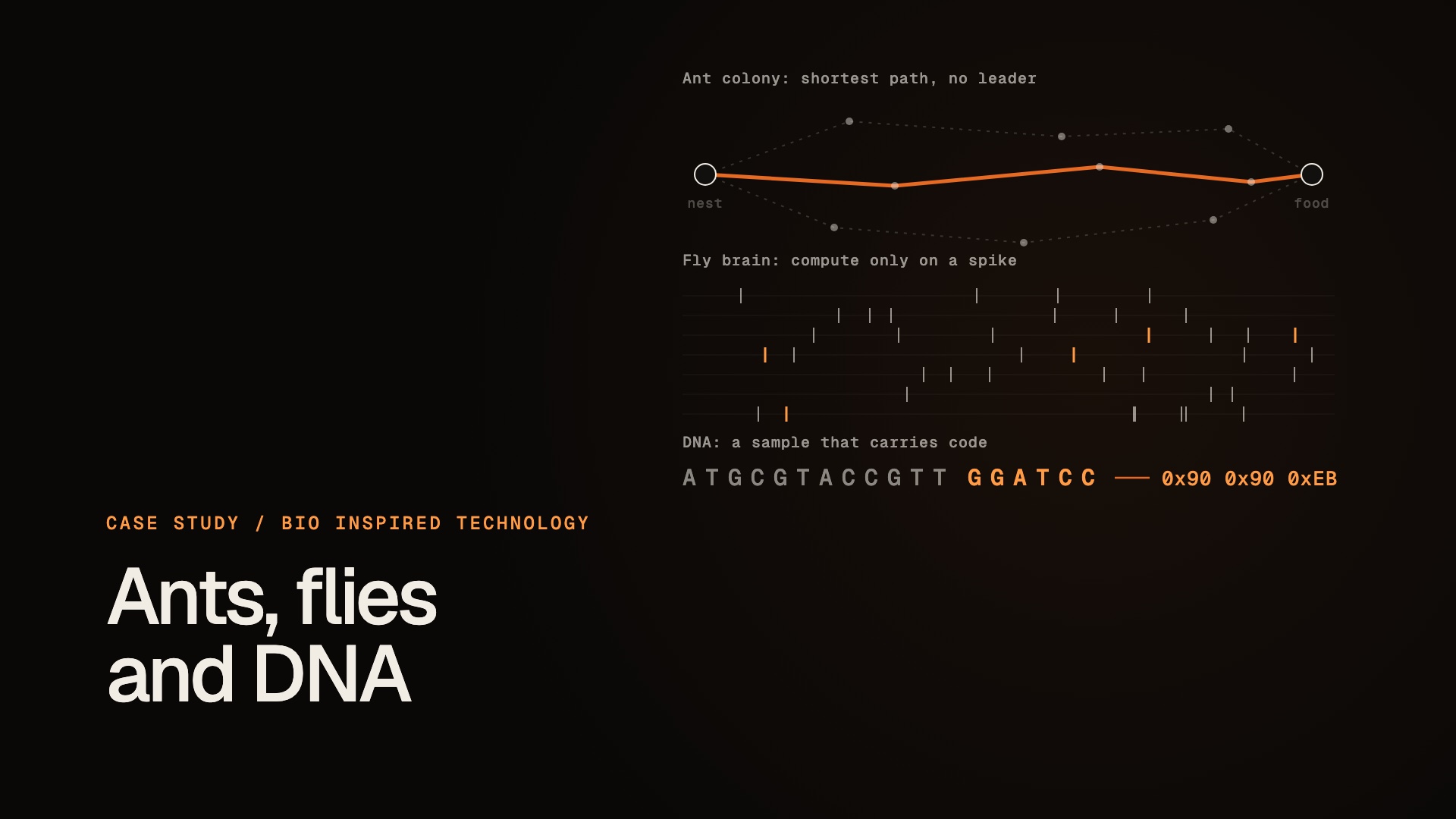
Ants find short paths to food with no leader and no map, and the colony keeps working when individual ants die. In the 1990 double bridge experiment, Jean Louis Deneubourg and colleagues gave Argentine ants two bridges to a food source. The colony settled on the shorter one through pheromone feedback alone. Marco Dorigo turned that behaviour into an algorithm in his 1992 PhD thesis. It is now called Ant Colony Optimization.
A fruit fly runs sight, smell, taste and flight on a brain of about 140,000 neurons and almost no energy. In October 2024 the FlyWire consortium published the first complete wiring diagram of an adult fly brain in Nature: 139,255 neurons and more than 50 million synapses, proofread by more than 200 people across about 50 labs. Around the same time, AI hardware kept running into the same wall. Most of its energy goes on moving data between memory and compute, not on the maths.
DNA is the third system, and it points the other way. Sequencing became cheap enough for hospitals and consumer testing, so DNA became data that flows into ordinary software. That software, and the instruments that feed it, were not built with an attacker in mind. What stands out to me is that the first two systems are biology used as a design, while the third is biology used as an input, and it has to be secured like one.
Analysis
Each system solves a clear problem in nature and a different one for us.
- Ants, in nature: find a good route and share work across thousands of individuals, with no manager and nothing lost when some die.
- Ants, for us: plan routes for vehicle fleets and data networks, and run groups of robots that keep working when members fail.
- The fly brain, in nature: react quickly to the world on a tiny energy budget.
- The fly brain, for us: run sensing and AI inside a small battery powered device, without sending data to a server.
- DNA, in nature: store and copy information reliably across generations.
- DNA, for us: a physical sample is now an input to a computer, so a genomics lab has a supply chain and an attack surface.
The mechanics are simple rules that add up to useful behaviour.
Ant Colony Optimization sends out many simulated ants. Each one builds a route step by step and picks the next step with a probability weighted by distance and by a pheromone value. Good routes get more pheromone, so later ants favour them. Pheromone also evaporates, which stops the search locking onto the first decent answer. No single ant holds the solution. The route emerges from many cheap attempts.
Spiking neurons work on a similar idea of doing nothing until something matters. In the leaky integrate and fire model, a neuron collects input, slowly leaks charge, and fires one spike when it crosses a threshold. The rest of the time it is silent, and silence costs almost nothing. A GPU works the other way. It recomputes every value on every cycle, whether or not the input changed.
The fly result shows how far this simple model goes. Philip Shiu and colleagues ran the whole FlyWire connectome as a leaky integrate and fire network on a laptop. When they activated the sugar sensing neurons, the model produced the feeding response a real fly shows. Across 164 predictions tested against experiments, it matched about 91%. A full wiring diagram plus a very basic neuron was enough to predict real behaviour.
The DNA story is about ordinary software meeting unusual input. In 2017, Peter Ney, Tadayoshi Kohno and colleagues at the University of Washington showed that a synthetic DNA sample, once sequenced, could carry data that took control of an analysis program. They added a known memory flaw to the program themselves, so this was a proof of concept, not an attack on real tools. The same study then checked 13 widely used open source programs for reading DNA data. It found unsafe coding patterns far more often than in software that routinely faces attackers, and found three memory bugs without much effort. The researchers were clear that the public had no cause for alarm yet.
What actually exists today is narrower than the headlines suggest.
- ACO in logistics software: AntOptima's AntRoute planned routes for Number 1 Logistics Group in Italy, which ran 2,600 vehicles, and for the Swiss fuel distributor Pina Petroli.
- ACO in network routing: AntNet beat OSPF, a standard internet routing protocol, on throughput and delay, but only in simulation.
- Lab robot swarms: 1,024 Harvard Kilobots assembled into shapes in 2014, and ten small drones flew through a bamboo forest in 2022 using only onboard sensing.
- A complete fly brain model: the FlyWire data and the whole brain model are open, and the model runs on a laptop.
- Spiking chips you can buy: Innatera's Pulsar launched in May 2025 and BrainChip's Akida Pico is specified at under one milliwatt.
- Research scale systems: Intel's Hala Point went to Sandia National Laboratories in 2024, and a SpiNNaker 2 system followed in 2025.
- Real sequencer flaws: a CISA advisory in 2023 and Eclypsium's firmware findings in 2025 both concern Illumina instruments.
Spiking hardware puts memory next to compute and stays idle until something changes.
A standard processor keeps memory apart from the units that do arithmetic, so most of the energy in AI inference goes on moving data back and forth. Neuromorphic chips place memory beside each small compute core. IBM's NorthPole, a close relative that keeps all its memory on chip across 256 cores, reports 72.7 times better energy efficiency than a 4 nm GPU when running a 3 billion parameter language model at low latency. It does this on an older 12 nm process. Intel's Hala Point scales the idea up to 1.15 billion neurons and reports more than 15 trillion 8 bit operations per second per watt.
The second unusual choice is that nothing is computed when nothing changes. This is why spiking chips pair naturally with event cameras, whose pixels each report only when light changes, in under 100 µs.
The chips that are actually selling are not purely spiking. Innatera's Pulsar combines spiking blocks with a standard processor core and conventional accelerators for image and signal processing. It draws 600 µW for radar presence detection, company reported. The workable design is a spiking front end that stays awake cheaply and wakes ordinary silicon only when needed.
This could change the direction of AI hardware. Today the industry mostly makes models bigger and chips faster. Spiking hardware suggests another path: always on intelligence at the edge, and data centre inference that is priced by the events it handles rather than by every clock cycle. The limits are real. Spikes are not differentiable, so training uses workarounds, and spiking models still trail standard networks on many tasks. The software tools are split across vendors, and most results come from each company's own benchmarks on its chosen workloads.
The DNA pipeline has a different architecture problem: it has no trust boundary. A sample goes into an instrument, the instrument writes files, and later tools read them. Historically no stage treated the input from the previous stage as untrusted. The 2023 CISA advisory showed the same gap at the instrument level. Illumina's Universal Copy Service listened on every network address, rated 10.0 out of 10 as CVE-2023-1968, across sequencers including the iSeq 100, MiSeq, NextSeq and NovaSeq 6000. Illumina released a patch. In January 2025 Eclypsium found the iSeq 100 booting a 2018 BIOS with no Secure Boot and no firmware write protection, on a motherboard that other device makers also use.
The common thread is to copy the mechanism, not the animal.
- Copy the rule, not the shape: ACO keeps the loop of reinforcement and decay, not the ants.
- Many simple agents: each part knows only its neighbours, and the useful behaviour appears at the level of the group.
- Forgetting is a feature: pheromone evaporation and neuron leak both let the system change its mind.
- On time beats perfect: these are approximation methods that trade a slightly worse answer for speed and low power.
- Biology is not special input: in genomics the lesson is to treat DNA data like any other untrusted file.
The tools are open in research and mostly closed in products.
- ACO: there is no dominant framework, and implementations live inside planning products such as AntRoute. Which large logistics products still use ACO internally is unconfirmed.
- Intel Loihi 2: programmed through Lava, Intel's open source framework.
- Innatera Pulsar: programmed through the Talamo SDK, which is built on PyTorch.
- Spiking research: commonly uses open tools such as snnTorch, Brian2 and NEST, though which one a given lab uses varies.
- FlyWire: open data with download and programmatic access, and the whole brain model code is public.
- Sequencing instruments: Windows based control software on third party motherboards, confirmed for the iSeq 100 by Eclypsium.
Each pillar reached the world through a different door.
Ant Colony Optimization is the mature one. It is more than thirty years old and taught as standard in operations research. It reached the market inside logistics planning software rather than as a product with its own name. Swarm robotics has not crossed over. The Kilobots are twelve years old and the forest drone swarm is four, and there is still no mass market swarm product.
Connectomics reached scale through open community proofreading, and releasing the data openly is why a whole brain simulation could follow at once. Neuromorphic computing split into two paths. The research path sells large systems to national labs, as with Hala Point and SpiNNaker 2 at Sandia. The commercial path sells tiny always on chips into devices. At CES 2026 Innatera showed Pulsar inside partner products, including a smoke detector with radar presence sensing and a motor vibration monitor.
The DNA pillar reached the world as advisories and regulation, not products. The clearest case is 23andMe. Attackers reused passwords from earlier breaches elsewhere to get into accounts, and data on 6.9 million people was exposed in 2023. In June 2025 the UK Information Commissioner's Office fined the company £2.31 million for failing to require two factor sign in and for not checking before raw DNA data was downloaded. In the United States, the 2024 federal framework for screening DNA synthesis orders was ordered to be revised or replaced in May 2025, and the rules are still in flux.
What this means for the field is practical. Sequencers need patching and firmware checks like any medical device. Analysis software needs basic secure coding. Genetic data needs the strongest login protection a company offers, because unlike a password it cannot be changed. And DNA synthesis orders need screening that does not depend on shifting policy.
- Observe the organism
- Find the mechanism
- Reduce it to a rule
- Simulate it
- Build chip or software
- Find the winning job
- Ship inside products
Sources
- Nature, Oct 2024: FlyWire connectome, 139,255 neurons, 50 million synapses, 200+ contributors
- Nature, Oct 2024: whole brain fly model, about 91% of 164 predictions
- Berkeley News, Oct 2024: fly brain model runs on a laptop and predicts feeding
- arXiv review, Aug 2019: Dorigo's 1992 thesis and the double bridge experiment
- Di Caro and Dorigo, 1998: AntNet beats OSPF on throughput and delay in simulation
- LogForum, Dec 2006: AntRoute at Number 1 Logistics Group and Pina Petroli
- ScienceDaily, Aug 2014: 1,024 Kilobots self assembling with no central controller
- Science Robotics, May 2022: ten drones flying through a bamboo forest
- Intel, Apr 2024: Hala Point, 1.15 billion neurons, 15 TOPS per watt, 2,600 W, Sandia
- IBM Research, Oct 2023: NorthPole architecture with all memory on chip, 256 cores, 12 nm
- IBM at HPEC, Sep 2024: NorthPole 72.7x energy efficiency over a 4 nm GPU on a 3B model
- Innatera, May 2025: Pulsar launch, 600 µW and 400 µW figures, Talamo SDK on PyTorch
- Innatera, Dec 2025: Pulsar in partner products shown at CES 2026
- BrainChip, 2024: Akida Pico specified at under 1 mW
- HPCwire, Jun 2025: SpiNNaker 2 system deployed at Sandia
- Prophesee, May 2024: event sensor pixel latency under 100 µs
- USENIX Security, Aug 2017: DNA sample compromising analysis software, audit of 13 programs
- UW Allen School, Aug 2017: researchers say no cause for public alarm yet
- CISA, Apr 2023: Illumina Universal Copy Service advisory, CVSS 10.0, affected sequencers
- Eclypsium, Jan 2025: iSeq 100 with 2018 BIOS, no Secure Boot, no write protection
- UK ICO, Jun 2025: 23andMe fined £2.31 million, 6.9 million people affected
- ASPR, Aug 2026: DNA synthesis screening framework to be revised or replaced
Metrics
- 139kNeurons in the full fly connectomeThe first complete wiring diagram of an adult brain has 139,255 proofread neurons and more than 50 million synapses.
- 91%Match rate of the whole brain modelA simple spiking model built on the full connectome agreed with about 91% of 164 experimental predictions.
- 15 TOPS8 bit operations per watt, Hala PointIntel reports more than 15 trillion 8 bit operations per second per watt, at up to 2,600 W for the whole system.
- 1.15BNeurons in the largest neuromorphic systemHala Point links 1,152 Loihi 2 processors with 128 billion synapses in a chassis about the size of a microwave oven.
- 72.7xNorthPole energy efficiency over a GPUTokens per second per watt on a 3 billion parameter language model, against a 4 nm GPU, with NorthPole on an older 12 nm process.
- <1 mWPower of a spiking coprocessorBrainChip specifies Akida Pico at under one milliwatt for always on tasks such as voice wake up.
- 600 µWRadar presence detection on PulsarInnatera specifies 600 µW for radar presence detection and 400 µW for audio scene classification on its production chip.
- 1,024Robots in a self assembling swarmHarvard's Kilobots formed shapes using only messages to their neighbours, with no central controller.
- ~3 yrsUntil spiking inference is routine at the edgeEstimate: spiking chips are already inside partner smoke detectors and motor monitors as of early 2026, and about three years is a reasonable lag before they become an unremarkable default.
Next project
 Red Bull →