10 / Payments infrastructure
UPI: payments as layered infrastructure
An analysis of UPI as layered infrastructure: how splitting addressing, authentication, switching and settlement into separate layers let India's shared payment rails grow from a 21 bank pilot to about 24.5 billion payments a month.
- NPCI's Unified Payments Interface
- Fintech and public digital infrastructure
- September 2026
- Research and analysis
Context
India had bank accounts arriving and almost nothing to pay with.
In 2014, 53% of Indian adults had a bank account, according to the World Bank's Global Findex. The government's Jan Dhan scheme then opened accounts at enormous scale, and it stands at 59.09 crore accounts in August 2026. Aadhaar gave most residents a digital identity that banks could use for eKYC. Yet in March 2016 the whole country had only about 13 lakh card terminals. Most shops took cash.
The National Payments Corporation of India, a nonprofit owned by banks and overseen by the Reserve Bank of India, already ran IMPS, an instant transfer system that worked around the clock. UPI was built on top of that backbone. It launched as a pilot on 11 April 2016 with 21 banks and opened to the public on 25 August 2016.
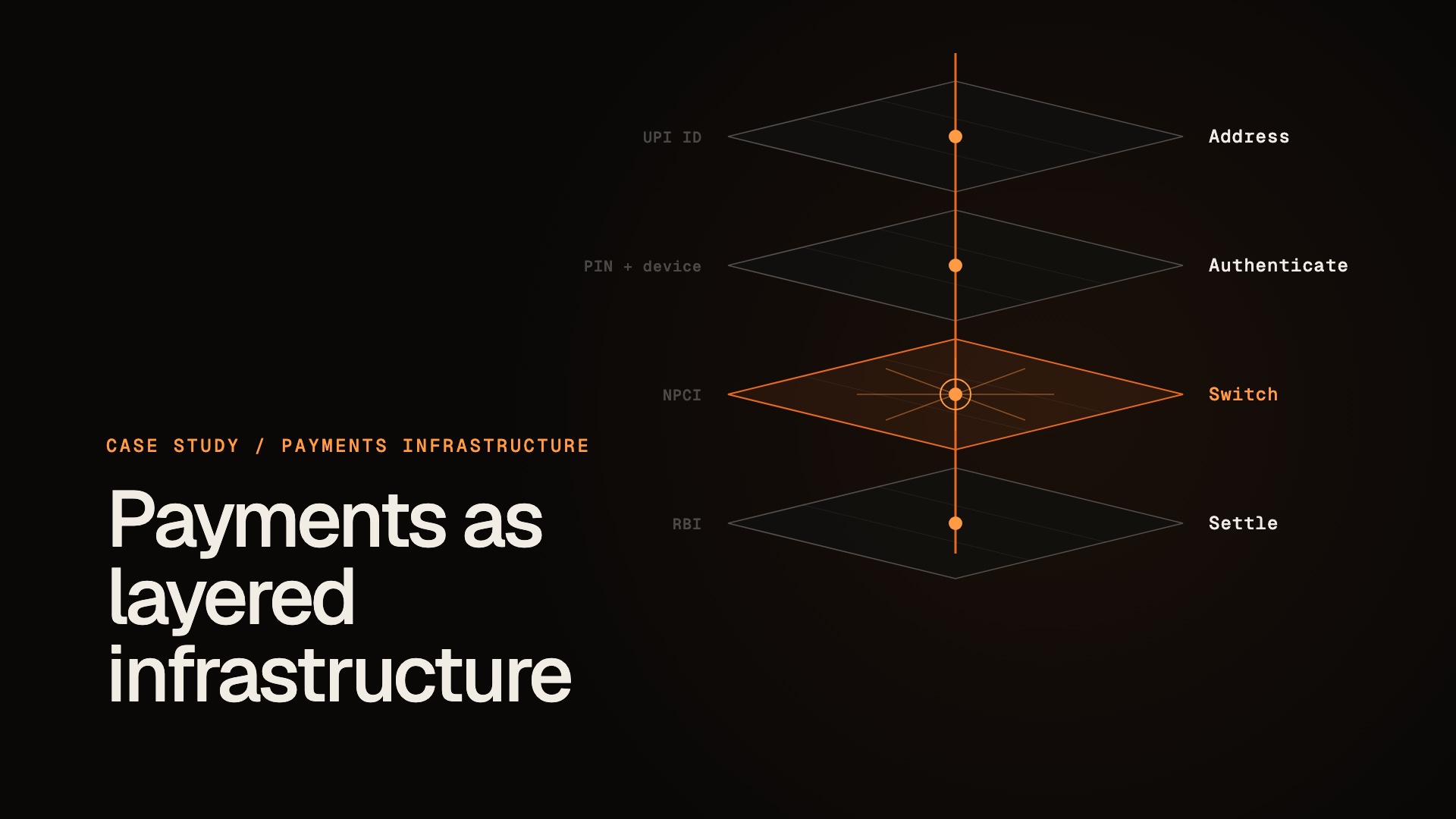
The usual telling of UPI is a growth story. What stands out to me is the architecture underneath. UPI is not an app or a bank. It is a set of rules for how apps, banks and one central switch talk to each other, and those rules split a payment into four layers: addressing, authentication, switching and settlement. Each layer has changed on its own schedule, which is why the system could grow from 21 banks to 741 without being rebuilt.
Analysis
Moving money meant knowing someone's bank details and having the right hardware.
Before UPI, sending money to another person usually meant typing their account number and the branch IFSC code into your own bank's app or website. Every bank built its app differently. IMPS was instant, but it still depended on those identifiers. For merchants, cards needed a terminal, a monthly rental and a merchant account, which a tea stall or vegetable seller could not justify. Mobile wallets existed, but each was a closed loop. Money in one wallet could not pay a merchant on another.
In a country with hundreds of banks, from large national lenders to small cooperative banks, the problem was not a lack of payment methods. It was that none of them spoke the same language to the payer. The goal UPI set was simple to state: any bank account, reachable from any app, on any phone, instantly, at no cost to the payer.
A payment is four separate jobs handled by four separate parties.
Every UPI payment involves four parties. The payer's PSP is the payment service provider bank behind the payer's app. The payee's PSP does the same for the person being paid. The remitter bank holds the payer's money, and the beneficiary bank receives it. NPCI sits in the middle as a switch. It routes messages and computes who owes whom, but it never holds customer funds.
Take a single payment at a shop. The customer scans a QR code, which mostly just encodes the merchant's UPI ID, also called a VPA, and sometimes an amount. The payee's PSP resolves that address to a real account. The customer's PIN is encrypted on the phone. NPCI routes the request, the remitter bank checks the PIN and debits the account, and the beneficiary bank credits the merchant. Both apps get a confirmation, usually within seconds. The banks themselves settle later, in bulk, through their accounts at RBI.
UPI supports both push payments, where the payer starts the payment, and pull or collect requests, where the payee asks and the payer approves. Collect requests between people became a common fraud route, so NPCI stopped them from 1 October 2025. Merchant collect requests at online checkout still work.
- Scan QR
- Resolve payee VPA
- PIN encrypted on device
- NPCI switch routes
- Remitter bank debits
- Beneficiary bank credits
- Net settle via RBI
New features arrive as small, limited tools on top of the same core flow.
Most of what UPI has added in the last two years follows one pattern. The core payment stays the same, and each new capability comes with its own narrow limits.
- Scan and pay: one printed QR code works with every UPI app, because it carries an address and not an app specific token.
- UPI Lite: small payments from a balance held on the device, without a PIN, up to ₹1,000 per payment and ₹5,000 in total.
- UPI 123PAY: payments from basic feature phones without an internet app, with a limit of ₹10,000.
- Biometric approval: since October 2025, fingerprint or face approval on the phone can replace the PIN for payments up to ₹5,000.
- UPI Circle: a primary user can let up to five trusted people pay from their account, capped at ₹15,000 a month under full delegation.
- Reserve Pay: one approval blocks up to ₹10,000 for up to 90 days, and a merchant can take several debits from it.
- AutoPay: recurring mandates for bills, subscriptions and investments.
- Credit on UPI: RuPay credit cards and credit lines a bank has already approved can sit behind the same UPI ID as a savings account.
The rails are old style XML messages with a few unusually strict design choices.
UPI's interfaces are XML messages sent over HTTPS, a lineage it shares with IMPS. The main messages are ReqPay, which a PSP sends to start a payment, and RespPay, which carries the result back. ReqAuthDetails lets the payee's PSP turn a UPI ID into the account details NPCI can route to. ReqValAdd validates an address. ListKeys fetches NPCI's current public key. These names come from NPCI's published API descriptions and bank developer documentation.
The most unusual piece is the Common Library. NPCI supplies this library, and every PSP app must embed it to capture the PIN. The library encrypts the PIN with RSA 2048 using NPCI's public key and hands the app only an encrypted credential block. The app passes that block along unchanged in ReqPay. The company that makes the app you tap on never sees your PIN. The bank that holds your account verifies it.
Settlement is the other deliberate choice. To the user, a payment is final in seconds. Between banks it is not. NPCI records each approved debit and credit, nets every bank's position, and settles through the banks' accounts at RBI in ten cycles a day. Disputes moved into separate cycles from November 2025. This accepts a short interbank exposure so that central bank money does not move for every small shop payment.
The switch has also had to police its own members. On 12 April 2025, some PSP banks sent repeated Check Transaction status requests, including for old payments, without waiting for replies. NPCI said success rates fell to around 50% for two hours during an outage of four to five hours. The fixes were limits, not more servers. Timeouts fell from 30 seconds to 15 seconds or less in June 2025. From August 2025, apps were limited to 50 balance checks a day and three status checks within two hours, and AutoPay moved out of peak hours.
The rails are shared and neutral, and the competition happens on top.
Reading the rule changes over ten years, a consistent point of view shows through.
- Identity is not the account: a UPI ID points to an account without exposing it, so users can switch apps or banks without changing how they get paid.
- Interoperability is required: any compliant app must reach any bank account, so no app can wall off its users.
- Credentials stay out of apps: the PIN is encrypted by NPCI's library and read only by the bank.
- Free for the payer: consumers have never paid to use UPI, and person to person payments remain free.
- Add small, limited tools: new use cases get new capabilities with hard caps, rather than changes to the core payment.
- Remove what fails: when collect requests became a fraud channel, they were switched off for payments between people.
The protocol is documented, but NPCI's internal stack is not public.
What can be confirmed is the contract between participants. How NPCI builds the switch behind that contract is not published, so anything beyond the items below would be guesswork.
- Messaging: confirmed as XML over HTTPS, with digitally signed messages, carried over from IMPS.
- PIN encryption: confirmed as RSA 2048 in the Common Library, using keys fetched through ListKeys.
- Settlement: confirmed as deferred net settlement through bank accounts held at RBI.
- Switch internals: unconfirmed, as NPCI's databases, programming languages and data centre layout are not public.
- App stacks: unconfirmed and specific to each company, since the rules fix only the interface.
A cash shock, cheap data and free acceptance did the distribution.
UPI's first months were quiet. On 8 November 2016 the government withdrew high value banknotes, and people suddenly needed ways to pay without cash. The government's own UPI app, BHIM, launched on 30 December 2016 and handled 43,000 transactions in its first month. At the same time, mobile data became cheap. The government puts the average price at ₹269 per GB in 2014 and ₹8.31 per GB in 2024, a fall driven largely by Jio's 2016 entry.
Merchant acceptance spread through printed QR codes, which cost almost nothing, and soundboxes that announce each payment aloud so the shopkeeper does not have to check a phone. From January 2020 merchants paid no fee at all on UPI. Banks and apps were compensated through an annual government incentive, set at ₹2,000 crore for the 2026 to 2027 financial year. The government reports about 56.86 crore QR codes deployed at roughly 6.5 crore merchants.
Today UPI has 55.49 crore users onboarded and 741 banks live. The IMF, in a June 2025 report, called it the world's largest retail fast payment system by volume. The government, citing ACI Worldwide, puts its share of global real time payment volume at about 49%. Usage is concentrated at the app layer. PhonePe held 46% and Google Pay 32.6% of volume in July 2026. NPCI has scheduled a 30% cap per app for 31 December 2026, after extending the deadline twice.
The economics are now changing. NPCI has announced a 0.4% merchant fee on payments to merchants above ₹2,000, effective 15 October 2026, capped at ₹300 per payment. Payments between people, AutoPay, all payments up to ₹2,000 and micro merchants receiving up to ₹1 lakh a month stay free. NPCI cites an industry estimate of about ₹20,000 crore a year to run UPI.
The user experience hides every detail the payer used to need.
UPI's user experience is mostly the architecture made visible. Each principle below removes something the payer once had to know or own.
- An address, not bank details: a UPI ID or QR code replaces the account number and IFSC code.
- One PIN per account: the same PIN works in every app, and the bank checks it.
- Scan and pay: the most common payment is pointing a camera at a printed code.
- Any app, any bank: interoperability means the payer and merchant never need the same app.
- Instant feedback: a confirmation arrives within seconds, and soundboxes read it out to the merchant.
- Room for basic phones: UPI 123PAY works on feature phones, and UPI Lite handles small payments without a PIN.
Sources
- MediaNama, Sep 2026: August 2026 volume, value, daily averages and growth
- NPCI via Department of Financial Services, Sep 2026: merchant fee terms, effective date and ₹20,000 crore industry estimate
- Business Today, Aug 2026: 741 banks live and 44 in the first financial year
- PIB, 2026: 55.49 crore users onboarded as of June 2026
- PIB, Dec 2025: QR codes and merchants, IMF recognition and ACI share of global volume
- People Matters, 2026: pilot with 21 banks on 11 April 2016
- Indian Economic Service, Arthapedia: UPI built on IMPS and public from 25 August 2016
- CGAP, 2015: India account ownership of 53% in the 2014 Global Findex
- Business Standard, May 2017: about 13 lakh card terminals in March 2016
- ETV Bharat, Aug 2026: 59.09 crore Jan Dhan accounts
- NPCI API descriptions, mirror: ReqPay, RespPay, ReqAuthDetails, ReqValAdd and XML over HTTPS
- NPCI Common Library specification, 2021: PIN capture and RSA 2048 encryption with keys from ListKeys
- Federal Bank developer portal: ListKeys API
- Akashvani News, Dec 2024: data price of ₹269 per GB in 2014 and ₹8.31 per GB in 2024
- Wikipedia: BHIM launch on 30 December 2016 and first month volume
- Business Standard, Feb 2026: ₹2,000 crore incentive for the 2026 to 2027 financial year
- Inc42, Aug 2026: July 2026 app market shares
- Business Standard, Dec 2024: 30% cap deadline moved to December 2026
- MediaNama, Aug 2025: collect requests between people stopped from 1 October 2025
- Biometric Update, Oct 2025: biometric approval and ₹5,000 limit
- Paytm, 2025: UPI Lite limits
- Business Standard, Nov 2024: UPI 123PAY limit of ₹10,000
- Paytm, 2024: UPI Circle users and limits
- NPCI, 2025: Reserve Pay circular
- Pine Labs, 2025: Reserve Pay limit, 90 day block and gateway support
- NPCI, 2025: separate settlement cycles for disputes
- Angel One, Oct 2025: ten daily settlement cycles through RTGS
- Outlook Money, Apr 2025: 12 April 2025 outage and success rates
- Outlook Money, 2025: timeouts cut from 30 seconds in June 2025
- SCC Online, Jul 2025: balance and status check limits from August 2025
Metrics
- 24.5BPayments in August 2026A record month worth ₹29.82 lakh crore, up 22% in volume on August 2025, according to NPCI data.
- 791MPayments per dayThe daily average across August 2026, up from 763 million in July.
- ~9,150Average per second, derivedEstimate: 24.51 billion payments divided by 31 days and 86,400 seconds, an average across the whole day and not a peak.
- ≤15 sPayment timeout ceilingNPCI cut the request and response timeout for payments from 30 seconds to 15 seconds in June 2025; this is an upper bound, not the typical time.
- 10Settlement cycles a dayInterbank positions are netted and settled through RBI in ten cycles, with disputes moved to their own cycles from November 2025.
- 741Banks liveBanks live on UPI in July 2026, up from 44 in the 2016 to 2017 financial year.
- 56.9CrQR codes deployedAbout 56.86 crore QR codes at roughly 6.5 crore merchants by the 2024 to 2025 financial year, per the government.
- 55.5CrUsers onboardedNPCI reported 55.49 crore users onboarded on UPI as of June 2026.
- 90 dReserve Pay windowOne approval can block up to ₹10,000 for as long as 90 days for several later debits, and payment gateways already document it, so usage billing and agent style payments can use it now.
Next project
 Quantum × AI: the microsecond model →